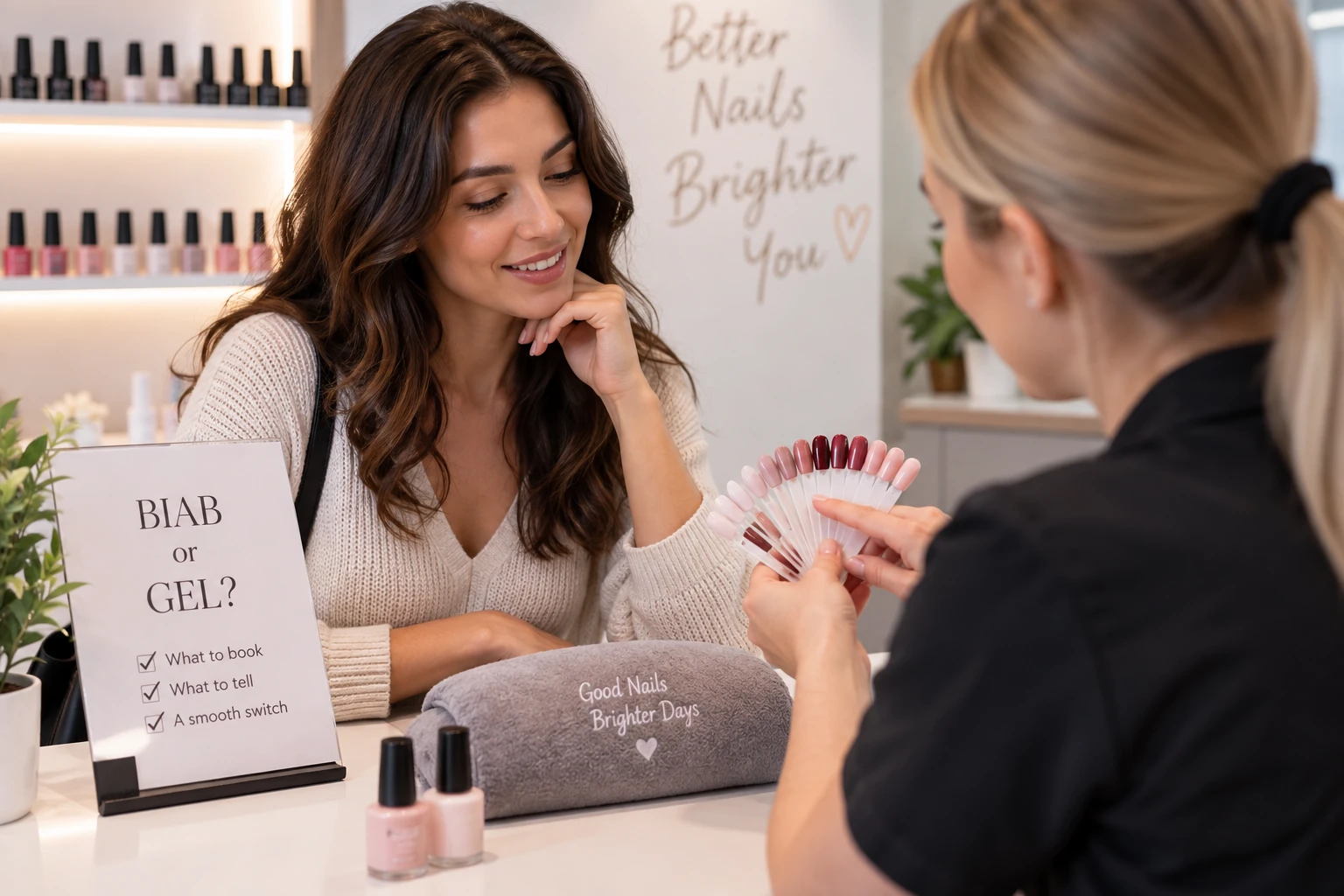
Changing nail salons while wearing BIAB or gel is easier when the new technician knows what is already on your nails. A standard infill appointment may not leave enough time to assess unfamiliar product, remove lifting or change the structure. Booking the right service starts before you arrive.
You do not need to apologise for choosing another salon. You do need to describe the current set honestly, including any discomfort, repairs or product you applied yourself. That information helps the technician decide what can reasonably be done during the appointment.
Ask about existing product before booking an infill
Salons have different policies about working over another technician’s application. Some accept it after assessment; others book removal and a fresh service. A refusal to infill unfamiliar product is not, by itself, a judgment about the previous salon.
The new technician may not be able to identify the product, its preparation or the condition underneath from a photograph. They also need to know whether the requested length and finish are suitable for the existing structure.
Ask a direct question: “I have builder gel from another salon. Do you assess existing work for an infill, or should I book removal and a new application?” If the answer depends on inspection, agree on an appointment that allows time for that uncertainty.
Find out what product you are wearing
BIAB is a product name associated with The GelBottle, while builder gel is a wider category. The terms are sometimes used loosely in conversation. Saying “BIAB” does not always establish exactly what was applied.
If possible, ask the previous salon for the brand, product range and whether the set includes tips or another enhancement underneath. You do not need to request its full working procedure. Basic product identification is enough to give the next technician a better starting point.
Removal methods differ between systems. Some products soak off, while others require filing, and the name of a colour alone may not identify the complete system. Do not assume that every gel in a bottle can be removed in exactly the same way.
Send clear photos and useful details
If the salon invites photographs, take them in good light without filters. Show both hands from above, the sides if possible and any nail with a crack or lifted area. A clear photo helps with booking, but it cannot replace an in-person assessment.
- Say when the current set was applied and whether it has already been infilled.
- Describe the length and shape you want at the new appointment.
- Mention extensions, repaired nails, glue or press-ons applied at home.
- Explain whether there is pain, itching, redness, lifting or an unusual colour.
- Tell the salon if you want a simple colour, detailed art or a major change in length.
A small colour change and removal of a long, damaged enhancement are different bookings. The more accurate the description, the less likely the appointment is to end with an unexpected limitation.
Understand what the assessment is for
The technician will need to consider adhesion, growth, shape and the visible condition of the natural nail and surrounding skin. A set that looks tidy from above may have lifting at the edges or an imbalance caused by growth.
Adding product over a problem does not make that problem disappear. If lifting needs to be removed or the structure needs substantial rebuilding, the service may differ from a routine infill.
There is also no need to assume every change of salon requires the most aggressive removal. The appropriate approach depends on the known product, its condition and the next service. The guide to builder gel infills and full removal explains the distinction in more detail.
Do not remove the set yourself to save appointment time
Peeling or levering off product can damage the natural nail. Filing at home can also make it harder to distinguish the original problem from damage caused during removal. If a new salon asks you to arrive without product, clarify how professional removal should be arranged.
A loose corner is not an invitation to pull the rest away. Keep the nail from catching, avoid picking and contact the salon for guidance about a suitable appointment. If a nail is painful or injured, describe that before anyone plans a new application.
Do not cover a suspicious area with extra glue or colour simply to make the set look better for the visit. The technician needs to see what has changed.
Symptoms can change the plan
Itching, swelling, a rash or persistent discomfort should not be treated as a routine reason to try another gel brand. Stop plans for a fresh application and seek medical advice about the symptoms. A nail technician can recognise when a service should not proceed, but cannot diagnose an allergy or infection.
Tell the clinician and salon what products were used if that information is available. Do not test uncured gel on your skin to see whether it causes a reaction. For relevant warning signs, read about itching after gel or BIAB nails.
An unfamiliar discolouration, separation of the nail or ongoing tenderness also deserves assessment before it is covered. A new colour should not conceal a condition that needs attention.
Confirm the price and time before the appointment
Ask whether the booking includes removal of existing product, repairs, a fresh application and the desired nail art. Some salons list removal of another salon’s product separately. The total should be clear before the work begins.
If the final service depends on inspection, ask which outcomes are possible and how the price would change. You might proceed with a fresh set, choose a simpler finish or have removal only. Agreeing on that range is more useful than expecting a guaranteed finish from photographs.
Allow enough time for the actual service. The guide to nail appointment lengths in Ireland can help you distinguish a short colour appointment from removal, rebuilding and detailed art.
Leave with a maintenance plan for the new set
Before leaving, ask which product was used, when the technician recommends the next assessment and what to do if lifting or damage appears. Keep the product name with your appointment details so that you do not have to reconstruct the history at the next change of salon.
The useful result is a service matched to your nails and the product actually present. Clear information, realistic appointment time and an agreed plan make the change of salon much more straightforward.