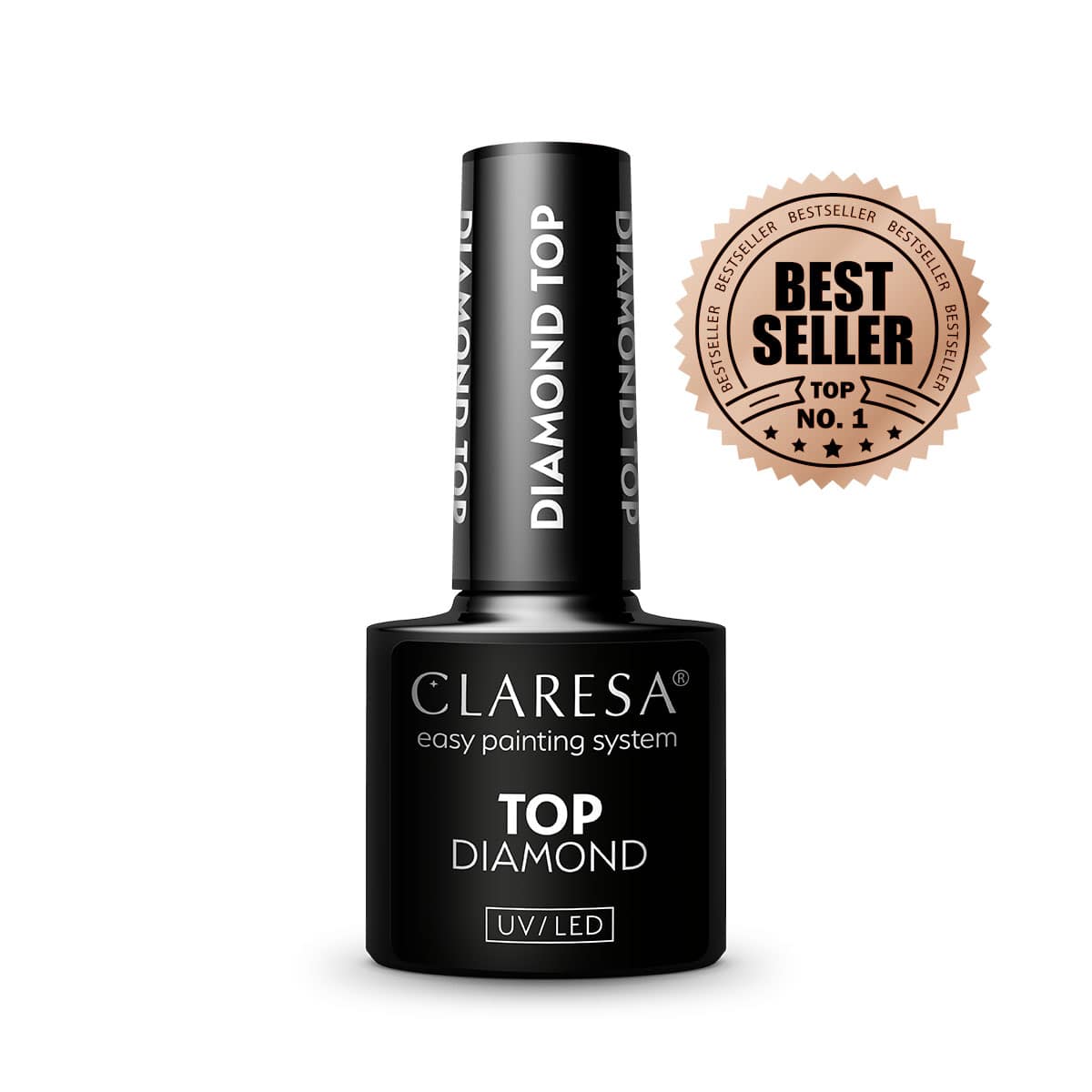
Quick answer: Claresa Diamond Top No Wipe and Claresa Top Glass No Wipe are both clear, glossy finishing coats that do not leave a sticky dispersion layer. Diamond Top has published curing times and is expressly presented for gel polish, gel and acrylic systems. Top Glass is described as a thin-consistency top designed to create a highly reflective, wet-look finish over cured Claresa gel polish. The available product information does not establish that either top is universally better or more durable than the other.
Claresa Diamond Top and Top Glass at a glance
| Feature | Claresa Diamond Top No Wipe | Claresa Top Glass No Wipe |
|---|---|---|
| Product type | Clear no-wipe top coat | Clear no-wipe top coat |
| Published pack size | 5 ml | 5 g |
| Published finish | Intense high gloss | Reflective wet-look gloss |
| Published consistency | Not specified on the current product page | Thin |
| Dispersion layer | No | No |
| Published system compatibility | Gel polish, gel and acrylic | Application over cured Claresa gel polish is expressly described |
| Published LED curing time | 30 seconds | No exact time stated on the current product page |
| Published UV curing time | 120 seconds | No exact time stated on the current product page |
| Published wear claim | Up to three weeks | Up to three weeks |
| Professional-use warning | Yes | Yes |
| HEMA named in the published ingredient list | Yes | No, but the product is not expressly advertised as HEMA-free |
| Price when checked | €4.95 including VAT | €4.95 including VAT |
| Availability when checked | In stock | In stock |
Prices, availability and formulations can change. The current product page and product packaging should always be checked before purchase and use.
What do the two top coats have in common?
Both products complete a cured nail system with a clear, glossy protective layer. Neither leaves the sticky dispersion layer associated with some traditional top coats, so a cleaner is not required after the final cure when the products are used according to their instructions.
Both are marketed as professional-use products and carry warnings that they may cause an allergic reaction. Skin contact should be avoided, and the directions for use must be followed carefully.
The two tops are therefore designed for broadly similar points in a manicure routine: they are applied after the colour or construction layer has been cured. The meaningful differences concern the type of finish described, the published consistency, documented compatibility and the amount of application information available.
What is Claresa Diamond Top No Wipe?
Claresa Diamond Top No Wipe 5 ml is presented as a clear, high-gloss finishing top for gel polish, gel and acrylic nail systems.
Its current product page highlights flexibility, elasticity, scratch resistance and resistance to yellowing. Claresa also publishes specific curing instructions: one layer of Diamond Top should be cured for 30 seconds in an LED lamp or 120 seconds in a UV lamp.
The product is a no-wipe top, so it does not provide the sticky dispersion layer needed by certain decoration techniques. That distinction matters when a nail artist intends to add a product or decoration that depends on a tacky surface.
Diamond Top may be the more straightforward choice when the user wants:
- a clear, highly glossy finish;
- a no-wipe final layer;
- a top expressly described for gel polish, gel and acrylic systems;
- published LED and UV curing times;
- a top coat whose product page specifically mentions flexibility and elasticity.
These points describe the current published instructions. They do not prove that Diamond Top performs better than Top Glass under every salon or home-use condition.
What is Claresa Top Glass No Wipe?
Claresa Top Glass No Wipe 5 g is a clear no-wipe top described as having a thin consistency and a reflective wet-look finish.
Its current product page emphasises visual depth and clarity. Claresa presents it as a finish intended to make solid colours look deeper and reflective details more noticeable. The page specifically instructs the user to apply it over previously cured Claresa gel polish.
Top Glass may be the more relevant option when the user wants:
- a transparent no-wipe finish;
- a thin consistency;
- a wet-look or glass-like visual effect;
- added visual depth over gel-polish colour;
- a top expressly presented for application over cured Claresa gel polish.
The current product page does not specify an exact UV or LED curing time. A user should not copy the Diamond Top curing time and assume it automatically applies to Top Glass. The current label or instructions supplied with Top Glass should be followed.
The main difference: documented versatility or a specific visual finish
The clearest distinction is not that one product is “good” and the other is “bad”. They are positioned around different selection priorities.
Diamond Top has broader published compatibility. Its product page expressly mentions gel polish, gel and acrylic styling and provides defined curing times.
Top Glass has a more specific finish profile. Its product page expressly identifies a thin consistency and a reflective, wet-look result over cured gel polish.
This leads to a practical decision:
- choose Diamond Top when published system compatibility and exact curing instructions are the main priorities;
- choose Top Glass when a thin application and a specifically described wet-look finish are the main priorities.
This does not establish that Diamond Top cannot create a glass-like shine or that Top Glass cannot protect a manicure effectively. It only reflects the differences the current Claresa product pages document clearly enough to compare.
Do Diamond Top and Top Glass have the same amount of product?
The labels use different units:
- Diamond Top is listed as 5 ml, a unit of volume;
- Top Glass is listed as 5 g, a unit of mass.
Five millilitres and five grams should not automatically be treated as identical quantities. Converting between the two would require the density of each formula. No density information is provided on the current retail pages, so this comparison should not claim that the containers hold exactly the same usable amount.
This is also why a direct cost-per-millilitre comparison cannot be made from the published pack labels alone.
How do the published ingredient lists differ?
Claresa Diamond Top No Wipe
The current Diamond Top product page lists:
- Urethane Acrylates;
- HEMA;
- Ditrimethylolpropane Tetraacrylate;
- Pentaerythrityl Tetramercaptopropionate;
- Ethyl Trimethylbenzoyl Phenylphosphinate;
- Polyether Modified Polysiloxane.
Claresa Top Glass No Wipe
The current Top Glass product page lists:
- Acrylates Copolymer;
- Hydroxypropyl Methacrylate;
- Ethyl Trimethylbenzoyl Phenylphosphinate;
- Dimethicone.
The published formulas are therefore not identical.
HEMA appears by name in the current Diamond Top ingredient list. It does not appear by that name in the current Top Glass list. This does not provide a sufficient basis to advertise Top Glass as HEMA-free, allergy-free or safer. Claresa does not make those claims on the cited Top Glass page, and ingredients may change. The full ingredient list on the physical product packaging should take priority over an older online description.
Both product pages identify the products as intended for professional use, warn that an allergic reaction may occur and advise avoiding contact with the skin.
Which top is better for gel polish?
Both products can be considered for a gel-polish finish, but the published descriptions focus on different benefits.
Diamond Top is the clearer choice when the user wants exact published UV and LED curing times and a product expressly described for several nail systems.
Top Glass is the clearer choice when the desired result is specifically a thin, highly reflective, wet-look finish over cured Claresa gel polish.
Without a controlled side-by-side test, there is no reliable basis for stating that one of them is universally better for gel polish.
Which top is better for gel or acrylic extensions?
Diamond Top is expressly described on its product page as suitable for gel and acrylic styling as well as gel polish.
The current Top Glass page describes application over cured Claresa gel polish but does not expressly confirm the same wider compatibility. This does not necessarily mean that Top Glass cannot be used in another system; it means the retail page does not provide enough information to make that recommendation.
For gel or acrylic applications outside the published Top Glass instructions, confirmation should be obtained from the current manufacturer guidance before use.
Which product has the stronger shine?
Both products are marketed as high-gloss finishes, but the descriptions use different language:
- Diamond Top is presented around intense, sustained high gloss;
- Top Glass is presented around a reflective, wet-look effect and visual depth.
These are marketing descriptions rather than results from a published comparative gloss measurement. There is no objective gloss-unit result or controlled side-by-side test on the cited pages.
A responsible comparison can therefore describe the intended appearance, but it should not state that one product is objectively shinier than the other.
Which product lasts longer?
The current retail descriptions associate both products with wear of up to three weeks. However, the cited pages do not publish a controlled comparison conducted under identical preparation, lamp, application and wear conditions.
Actual wear can be influenced by:
- preparation of the natural nail;
- compatibility between the base, colour and top;
- application thickness;
- lamp output and curing;
- contact with surrounding skin;
- nail length and structure;
- exposure to chemicals and physical wear;
- adherence to the product instructions.
It would therefore be misleading to declare either product the longer-lasting option solely from the currently published information.
Can either top be used for decorations that need a sticky layer?
Both products are no-wipe tops and therefore do not leave a standard sticky dispersion layer after curing.
Diamond Top is expressly presented as unsuitable when the intended decoration requires that sticky layer. The same practical limitation follows from the no-wipe character of Top Glass: a technique that depends on a dispersion layer will require a compatible product or a different application method.
For techniques such as pigments, foils or other effects, the instructions for the decorative product should also be checked. Not every decoration is applied in the same way.
Claresa Diamond Top vs Top Glass: which should you choose?
Consider Diamond Top when:
- you use gel polish, gel or acrylic systems;
- you want exact curing times published on the product page;
- you want a clear no-wipe finish;
- flexibility and elasticity are stated priorities;
- you do not require a sticky dispersion layer for the next step.
Consider Top Glass when:
- the main goal is a glass-like, wet-look finish;
- you prefer a top described as having a thin consistency;
- you want to increase the visual depth of a cured gel-polish colour;
- you want a transparent no-wipe finish;
- you will verify the applicable curing time from the current product instructions.
Consider another top when:
- you want a matte result;
- you want a milky or tinted finish;
- you want glitter, foil or another decorative effect built into the top;
- your next decoration requires a dispersion layer;
- either product is incompatible with the system specified by its manufacturer.
Final verdict
Claresa Diamond Top No Wipe and Claresa Top Glass No Wipe are closely related products, but their current documentation supports different reasons for choosing them.
Diamond Top is the better-documented option for users who need a no-wipe top expressly described for gel polish, gel and acrylic systems, together with specific UV and LED curing times.
Top Glass is the more specifically described option for users seeking a thin top with a reflective wet-look finish over cured Claresa gel polish.
This is a difference in documented use and finish, not proof that either product is universally superior. Users should choose according to the nail system, desired finish and current instructions rather than relying on the product name alone.
Frequently asked questions
Are Claresa Diamond Top and Top Glass both no-wipe?
Yes. Both current product pages state that the top does not leave a dispersion layer and does not need to be cleaned after curing.
Is Top Glass the same product as Diamond Top?
No. The products have different published names, descriptions and ingredient lists. Diamond Top is sold in 5 ml, while Top Glass is sold in 5 g.
Does Claresa Diamond Top contain HEMA?
HEMA appears in the ingredient list published on the current Diamond Top product page. The packaging should still be checked because formulations and online ingredient information can change.
Is Claresa Top Glass HEMA-free?
The current online ingredient list does not name HEMA, but Claresa does not expressly advertise the product as HEMA-free on the cited page. The absence of the word from the online list should not be turned into an allergy-free, HEMA-free or safety claim without confirmation from the current packaging or manufacturer.
How long should Diamond Top be cured?
The current Diamond Top instructions specify 30 seconds in an LED lamp or 120 seconds in a UV lamp.
How long should Top Glass be cured?
The current Top Glass retail page instructs the user to cure the product in a lamp but does not provide an exact time. The current packaging or manufacturer instructions should be consulted rather than automatically applying the Diamond Top curing time.
Can Top Glass be used over acrylic nails?
The current Top Glass page specifically describes use over cured Claresa gel polish. It does not provide enough information to confirm acrylic compatibility. Diamond Top, by comparison, is expressly described for gel polish, gel and acrylic systems.
Which product is more durable?
Both are marketed with wear claims of up to three weeks, but no controlled side-by-side test is published on the cited pages. The available information does not establish that one is more durable than the other.