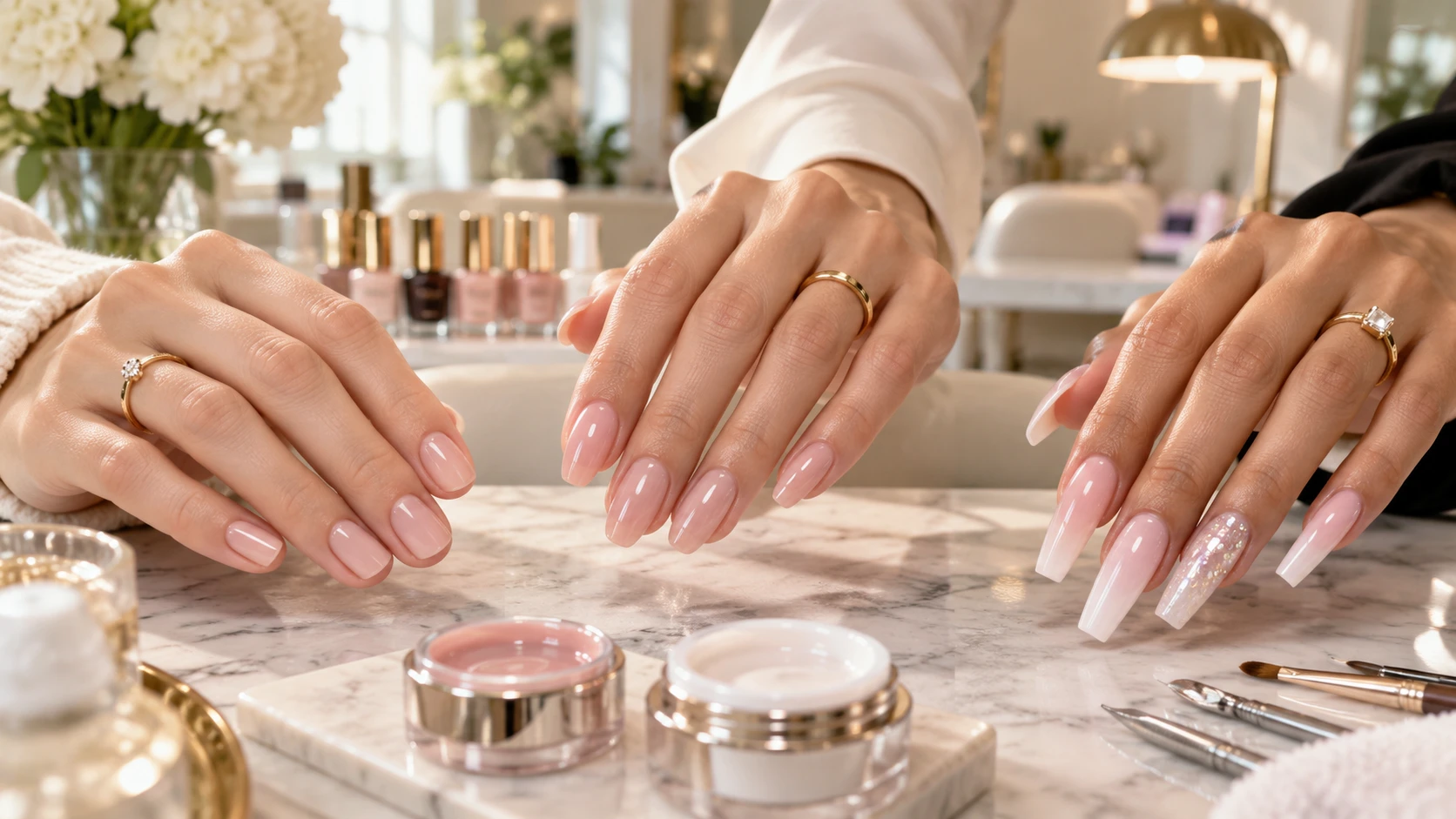
BIAB, hard gel and acrylic can all add strength or length, but they are not interchangeable services. BIAB-style builder gel is commonly chosen for overlays and short-to-medium structured natural nails; hard gel is useful when a salon needs a non-soak-off gel structure with more architectural support; acrylic is a liquid-and-powder system that can create strong extensions and repairs. The best appointment depends on your current nail length, flexibility, lifestyle, maintenance habits and the exact products the salon uses.
The label alone does not tell you whether a service will suit you. “Builder gel” can describe different formulas, and salons may use different brands, viscosities and application systems. Before booking, ask what product will actually be used, whether it is intended as an overlay or extension system, how it is removed and what maintenance interval the technician recommends.
Quick comparison: BIAB, hard gel and acrylic
| Service | Typical use | Removal | Best question to ask |
|---|---|---|---|
| BIAB / soak-off builder gel | natural-nail overlay, structure, some short extensions depending on system | often soak-off or file-and-soak, depending on formula | Is this exact builder product soak-off? |
| Hard gel | structured overlays and extensions | generally filed off rather than soaked off | How much product is left at infill? |
| Acrylic | strong overlays, extensions and repairs | depends on system; commonly filed and/or soaked appropriately | What maintenance and removal method do you use? |
What is BIAB?
BIAB is widely used as shorthand for “builder in a bottle”, although BIAB is also strongly associated with specific branded systems. In salon conversation, clients often use the term more broadly to mean a bottled builder gel overlay.
A builder overlay adds structure over the natural nail. Rather than painting the nail with only a thin colour layer, the technician can create a controlled apex and reinforce areas that flex or break.
For short natural nails, this can be a practical middle ground between ordinary gel polish and a full extension service. The guide Short Natural Nails: Gel Polish, Builder Gel or Extensions explains that choice in more detail.
What is hard gel?
Hard gel is a gel system that cures into a durable structure and is generally removed by filing rather than soaking it away like a soak-off product. It can be used to build length, reinforce natural nails and create a more substantial architecture.
That makes it useful when a client wants longer extensions or when a technician prefers a file-off structure for repeated infills. It also means removal should be planned. A hard gel service is not something to pick off at home when you want a colour change.
What is acrylic?
Acrylic nail enhancement usually combines a liquid monomer and polymer powder. The material begins to set through the chemical reaction of the system rather than being cured as a gel layer in a UV/LED lamp.
Acrylic can create durable extensions and strong repairs, but application quality matters. Thickness, apex placement, cuticle control, sidewall shape and filing all affect how the finished nail looks and wears.
Which is best for short natural nails?
If your goal is simply to grow short natural nails while keeping a relatively natural profile, a builder-gel overlay may be the most familiar salon option. It can reinforce the nail while keeping the service focused on the natural length.
That does not mean builder gel is automatically “healthier” or that every short nail needs it. Some clients are perfectly suited to standard gel polish. Others may be better off with no enhancement while a nail problem is assessed.
Which is best for long extensions?
Longer nails create more leverage. The free edge acts like a longer lever whenever the nail hits a surface. Structure therefore becomes increasingly important as length increases.
Hard gel and acrylic are both commonly used for longer extensions. The better choice depends on the technician’s system, the desired shape and length, your maintenance schedule and how you use your hands.
Do not book “the strongest possible product” as a substitute for realistic length. If your job involves frequent lifting, cleaning, gloves, machinery or hands-on work, a shorter enhancement may survive better than a very long one regardless of material.
What if your nails are flexible?
Very flexible natural nails move. An enhancement that is too rigid or poorly structured can experience stress at the interface between product and natural nail. On the other hand, a product that is too flexible for the requested length may not provide enough support.
This is where an experienced technician’s assessment matters more than social-media labels such as “BIAB is always best” or “acrylic is always strongest”.
Infill, rebalance or full removal?
As the nail grows, the apex and stress area move forward. Maintenance is not only about filling the visible gap at the cuticle. The structure may need to be rebalanced.
Builder gel, hard gel and acrylic can all involve maintenance appointments, but the process differs by product and nail condition. If lifting is present, loose material should not simply be covered.
For builder services, see Builder Gel Infill or Full Removal?.
Removal method matters before you book
Ask the salon whether the exact product is soak-off, file-off or a combination. Do not assume that every product sold in a bottle can be soaked off or that every builder should be removed completely at each appointment.
Home picking and peeling can remove layers from the natural nail surface. If you know you will need the product removed for work, surgery, sport or another reason, tell the salon before the first appointment so the service can be planned around that timeline.
What about allergies and “HEMA-free” products?
Gel and acrylic nail products contain reactive chemistry, and uncured product should be kept off the skin. “HEMA-free” does not mean “allergy-proof” or “risk-free”; it only describes one part of the formulation.
Good application practice matters: controlled placement, no uncured gel on skin, correct product thickness and curing according to the manufacturer’s system. If a client develops persistent itching, swelling, blistering, nail separation or another suspected reaction, cosmetic product should not simply be covered with another layer.
The article HEMA-Free Gel Nails in Ireland explains why one ingredient claim should not be treated as a complete safety guarantee.
How long does each appointment take?
Time depends on removal, length, shape, repairs, nail art and whether the service is a fresh set or maintenance. A simple builder overlay on short nails is not the same appointment as a long sculpted almond set with removal and art.
If timing matters, send a photo and ask the salon for the service length before booking. The detailed guide to nail appointment times in Ireland gives useful planning ranges by service type.
Price should be compared by service, not by product word
Two salons may both advertise “builder gel” while one price includes removal, cuticle work, structured overlay and colour, and another charges those separately. Likewise, a hard-gel extension set is not directly comparable with a short natural overlay.
When asking for a price, specify:
- current natural nail length;
- desired final length and shape;
- whether existing product must be removed;
- how many repairs are needed;
- whether you want plain colour, French or nail art;
- whether this is a first set or an infill.
For current builder-service pricing context, see How Much Do BIAB Nails Cost in Ireland in 2026?.
Questions to ask the salon
- What exact product system do you use for this service?
- Is it intended for overlays, extensions or both?
- Is it soak-off or file-off?
- How often do you recommend maintenance for my length?
- Can you create the length I want safely with this system?
- What happens if one nail lifts or breaks?
- Does the quoted price include removal or infill?
- Which lamp and curing process is used for the gel system?
FAQ
Is hard gel the same as BIAB?
No. BIAB-style products are builder gels, often packaged in bottles, while hard gel is generally a file-off gel structure. Exact properties depend on the manufacturer.
Is acrylic stronger than builder gel?
“Stronger” is too simple. Wear depends on product properties, structure, length, nail condition, application and lifestyle. A well-designed shorter enhancement may outperform a badly structured longer one.
Can BIAB be used for extensions?
Some builder systems allow short extensions, while others are intended primarily for overlays. Follow the product system and technician’s training rather than assuming every builder bottle is suitable for length.
Which service looks most natural?
Any of the three can look natural when applied thinly and structured well. The final appearance depends more on shape, thickness, colour and filing than on the category name alone.
What should I book if I do not know?
Book a consultation or send the salon a clear photo of your current nails and a reference image of the length and shape you want. Let the technician recommend the service after seeing the starting point.