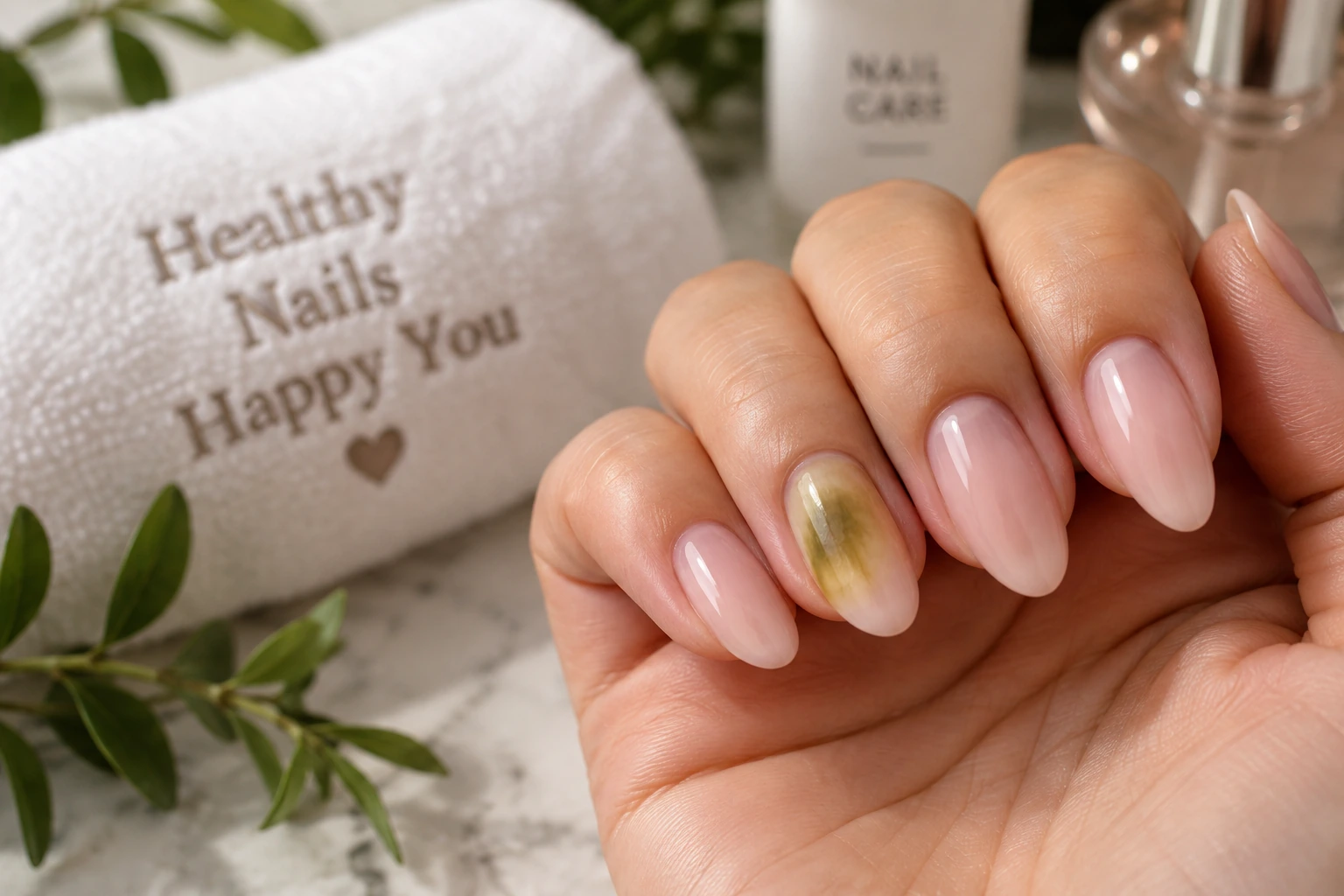
Seeing a green, yellow-green or dark green patch after BIAB, builder gel, gel polish or another enhancement can be alarming. The colour is often noticed when lifting product is removed or when an infill appointment exposes part of the natural nail. Whatever the shade, the safest approach is not to hide it under another layer of product before the nail has been properly assessed.
A green mark does not automatically tell you exactly what is happening. Discolouration can have several causes, and a photograph alone cannot confirm a diagnosis. In nail services, however, green staining is commonly associated with moisture becoming trapped in a lifted area and creating conditions in which bacteria can multiply. The practical priority is to remove the loose product safely, keep the nail clean and dry, and decide whether cosmetic treatment should stop until the nail has recovered.
Why can a nail turn green under gel or BIAB?
Enhancements work best when they remain firmly bonded to the natural nail. If part of the product lifts, a small pocket can form between the enhancement and the nail plate. Water can enter that space during hand washing, showering, swimming, cleaning or everyday work. The pocket may then stay damp for longer than the exposed natural nail would.
The problem is not simply “water under gel”. The concern is that a warm, moist and partially sealed space can support microbial growth. This is why repeatedly gluing, filing or painting over lifting is a poor strategy. The visible lift is a maintenance issue, but what is happening underneath it may require the enhancement to be removed.
If your builder gel has started lifting but there is no discolouration, the decision between repair, infill and removal is different. The guide to builder gel infill versus full removal explains what technicians normally assess when a client returns with growth or lifting.
Should a green nail be covered with fresh BIAB or gel?
Do not treat visible green discolouration as something that simply needs more opaque polish. Covering it makes the area harder to monitor and may recreate the sealed environment that contributed to the problem in the first place. A responsible nail professional may decline to apply new product to the affected nail even if the rest of the manicure can be serviced safely.
The aim is not to “seal in” the colour. The nail needs to be visible so changes can be monitored. If there is uncertainty about whether the nail is suitable for a cosmetic service, postponing the enhancement is safer than guessing.
What should you do when you notice a green patch?
- Do not pick or tear the enhancement off. Pulling bonded product can remove layers of the natural nail and leave it thinner and more vulnerable.
- Have lifted product removed carefully. The method depends on whether the system is soak-off or file-off and how much product remains bonded.
- Keep the nail clean and dry. Avoid prolonged soaking and do not trap it under an improvised patch or artificial tip.
- Do not share files or tools used on the affected nail. Reusable salon tools should be cleaned and disinfected according to appropriate hygiene procedures.
- Watch for changes. Pain, swelling, warmth, discharge, an unpleasant smell or redness around the nail are reasons to seek medical advice rather than book another cosmetic treatment.
Can you file the green colour off?
Aggressive filing is not a solution. Some staining may be within the upper layers of the nail plate, so trying to make the colour disappear by thinning the nail can cause unnecessary damage. The natural nail does not need to look perfectly clear on the same day the enhancement is removed.
As the nail grows, an old area of staining may gradually move toward the free edge. What matters is whether the nail remains comfortable and stable and whether the appearance is improving rather than spreading. If the colour changes, expands, returns after apparent improvement or is accompanied by symptoms around the nail, cosmetic filing should stop and the nail should be medically assessed.
How long should you wait before applying gel again?
There is no reliable universal number of days that applies to every green nail. The timing depends on what caused the discolouration, how the nail looks after product removal and whether there are any symptoms. A fixed rule such as “wait 48 hours and cover it again” can create false reassurance.
A nail professional can assess the condition of the nail plate from a service perspective, but diagnosis and treatment of infection belong with a doctor, pharmacist or other qualified healthcare professional. If the nail does not look normal enough for a safe cosmetic service, waiting is the sensible option.
When should you seek medical advice?
Seek medical advice promptly if the nail or surrounding skin becomes painful, swollen, hot, increasingly red, produces fluid or pus, or if the discolouration is spreading. Medical assessment is also important if the nail starts separating significantly from the nail bed or if the problem keeps returning.
People with diabetes, poor circulation, significant immune suppression or conditions that make infections more risky should use a lower threshold for getting professional medical advice. A manicure appointment should not be used to delay care when there are signs of inflammation or infection.
Can a salon prevent every green nail?
No system can eliminate every possible nail problem, but good preparation and maintenance reduce avoidable risk. The most important factors include correct nail preparation, full curing with compatible products and lamp settings, avoiding product on the surrounding skin, controlling lifting and repairing or removing compromised enhancements instead of repeatedly covering them.
Clients also play a role between appointments. Nails should be treated as enhancements rather than tools. Picking at lifted edges, using nails to open cans, prolonged exposure to cleaning chemicals without gloves and delaying maintenance for many weeks can increase the chance of lifting or breakage. For routine maintenance, see the guide to BIAB and gel nail aftercare between appointments.
Does HEMA-free or TPO-free gel prevent green discolouration?
Those labels address different questions. HEMA-free products relate to formulation choices around certain acrylate ingredients and allergy concerns, while TPO-free claims concern the photoinitiator system used in gel products. Neither label means an enhancement cannot lift or that moisture cannot get underneath it.
If product sensitivity is your concern, read more about what HEMA-free gel labels do and do not tell clients. If you are checking current product formulations, the guide to TPO-free gel nails in Ireland in 2026 explains that separate issue.
What should a nail technician do when only one nail is affected?
The unaffected nails can be assessed individually. It may be possible to maintain or reapply product to nails that are healthy and intact while leaving the discoloured nail bare. The technician should not feel pressured to create a perfectly matching ten-nail set at the expense of safety.
If the service proceeds on the unaffected nails, tools and work surfaces still need careful hygiene. A client should also receive clear home-care instructions and know what changes mean the affected nail needs medical attention.
How to choose a salon when you have had lifting before
Repeated lifting deserves more than simply switching to a stronger product. A good technician will look at nail condition, preparation, length, shape, daily activities, maintenance interval and whether the chosen system suits the client. Hygiene standards matter just as much as appearance. The checklist on what clients can check before a manicure covers practical signs of a well-run salon.
If you are comparing local options, browse nail services by location, including Dublin, Cork, Galway and Waterford. When booking, mention that you currently have or recently had nail discolouration so the salon can tell you whether it is appropriate to attend for a cosmetic service.
The key rule: do not hide a nail that needs to be seen
A green mark after BIAB or gel is a reason to inspect the nail, not to make the next layer more opaque. Remove compromised product safely, keep the nail visible, avoid aggressive filing and watch for pain, redness, swelling, discharge or progression. When the nail is not clearly suitable for a cosmetic service, medical assessment and time to recover take priority over the next manicure.