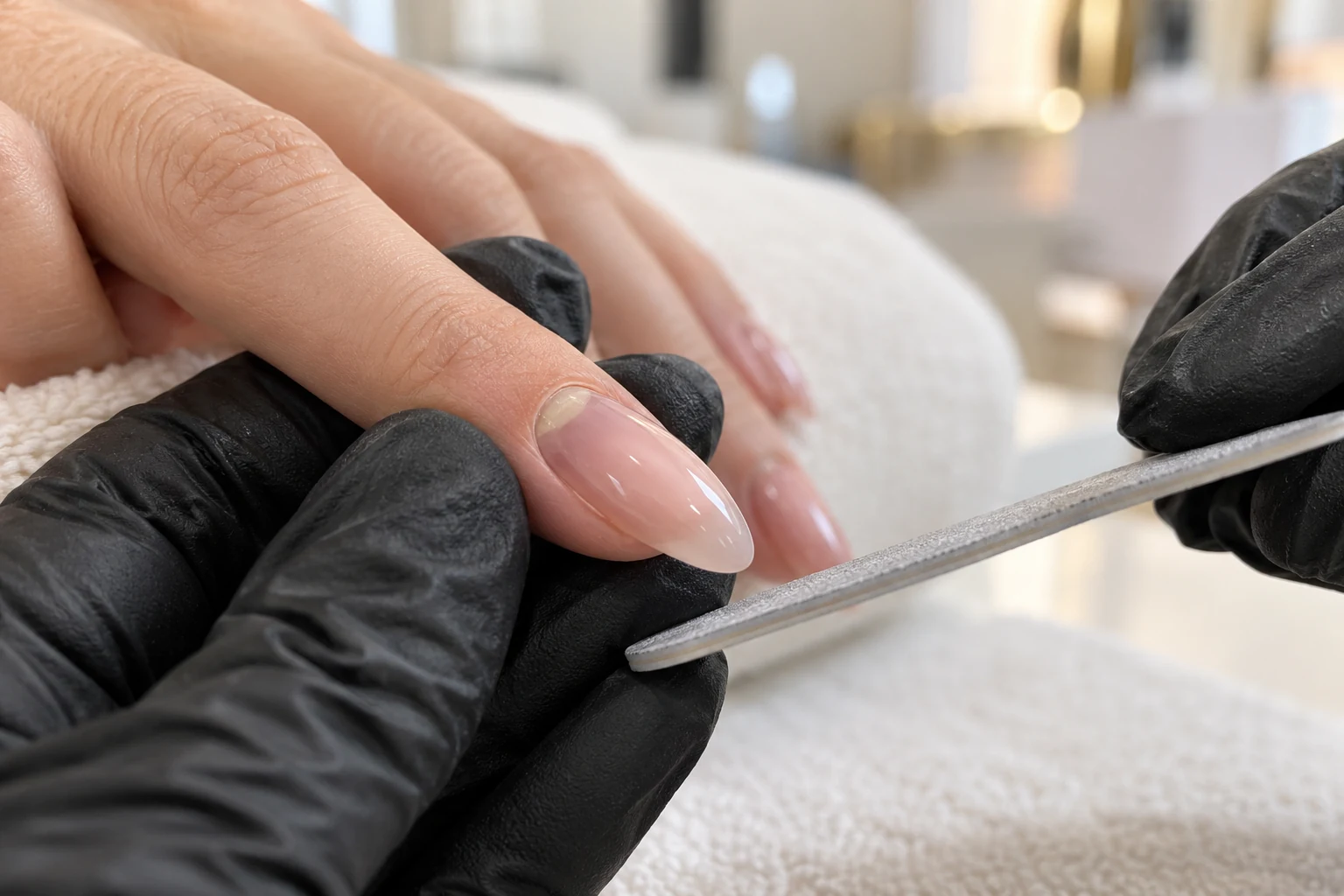
A gel overlay that grows out unevenly does not always need a full removal. If the product is well adhered and the natural nail is healthy, a structured rebalance can often restore the apex, sidewalls and overall shape. A simple infill is less suitable when the architecture has moved too far forward, the nail has changed direction, or lifting is present in several areas.
Why an overlay can look different after three or four weeks
The gel itself has not moved. The natural nail has grown underneath it, carrying the original structure toward the free edge. The highest point that once reinforced the stress area may now sit too far forward.
At the same time, daily use can slightly change the sidewalls and free edge. A client who types, cleans, boxes products or uses one hand more heavily may return with asymmetrical wear.
Infill versus rebalance
An infill describes filling the regrowth area. A rebalance goes further: the technician reduces old bulk where necessary and rebuilds the structure in the correct position.
| Situation | Likely service |
|---|---|
| small regrowth, shape still balanced | infill may be enough |
| apex has moved forward | rebalance |
| one sidewall has become heavier | reshape + rebalance |
| multiple lifted areas | remove unstable product and reassess |
| crack in natural nail | repair only if safe and appropriate |
What happens to the apex?
In a structured overlay, the apex helps distribute force. As the nail grows, the original apex can become visually and mechanically misplaced. Simply adding more gel at the cuticle may create a heavy nail with too much product overall.
A controlled rebalance removes unnecessary thickness before adding new structure.
Sidewalls and shape matter too
Uneven growth can make square nails look skewed and almond nails lose symmetry. The technician should check the nail from above, from the side and from the free edge. Filing only from the top can miss a sidewall that has become bulky.
When a full removal may be the better choice
Full removal may be appropriate if there is widespread lifting, product breakdown, suspected contamination, a major change of system, or uncertainty about what product is already on the nail. It may also be chosen when the client wants to return to natural nails.
Removal should be performed according to the product system. Not every builder product is designed to soak off completely.
Do not file through lifting
Detached product needs to be removed until the remaining enhancement is firmly attached. Sealing gel over a lifted pocket does not restore adhesion and can trap moisture or debris.
Why one nail may need more correction than the others
Natural nails do not all grow in identical directions. Index fingers and thumbs often experience different forces. A good service can therefore involve slightly different filing and structure on each nail while still producing a consistent finished set.
Gel safety still applies during maintenance
Keep uncured gel off the skin and follow the manufacturer’s application and curing instructions. Do not compensate for overly thick product with improvised curing times. Correct structure should come from controlled application, not from piling on extra gel.
What clients can tell the technician
- how long the set has been on;
- whether any nail caught or lifted;
- whether the shape now feels unbalanced;
- which products were used previously if changing salons;
- whether there has been itching, redness or swelling.
Frequently asked questions
Can every overlay be rebalanced?
No. The remaining product must be stable and compatible with the maintenance plan. Significant lifting or damage can make partial maintenance inappropriate.
Does a rebalance mean adding lots of gel?
No. It often involves removing old bulk first, then rebuilding only where structure is needed.