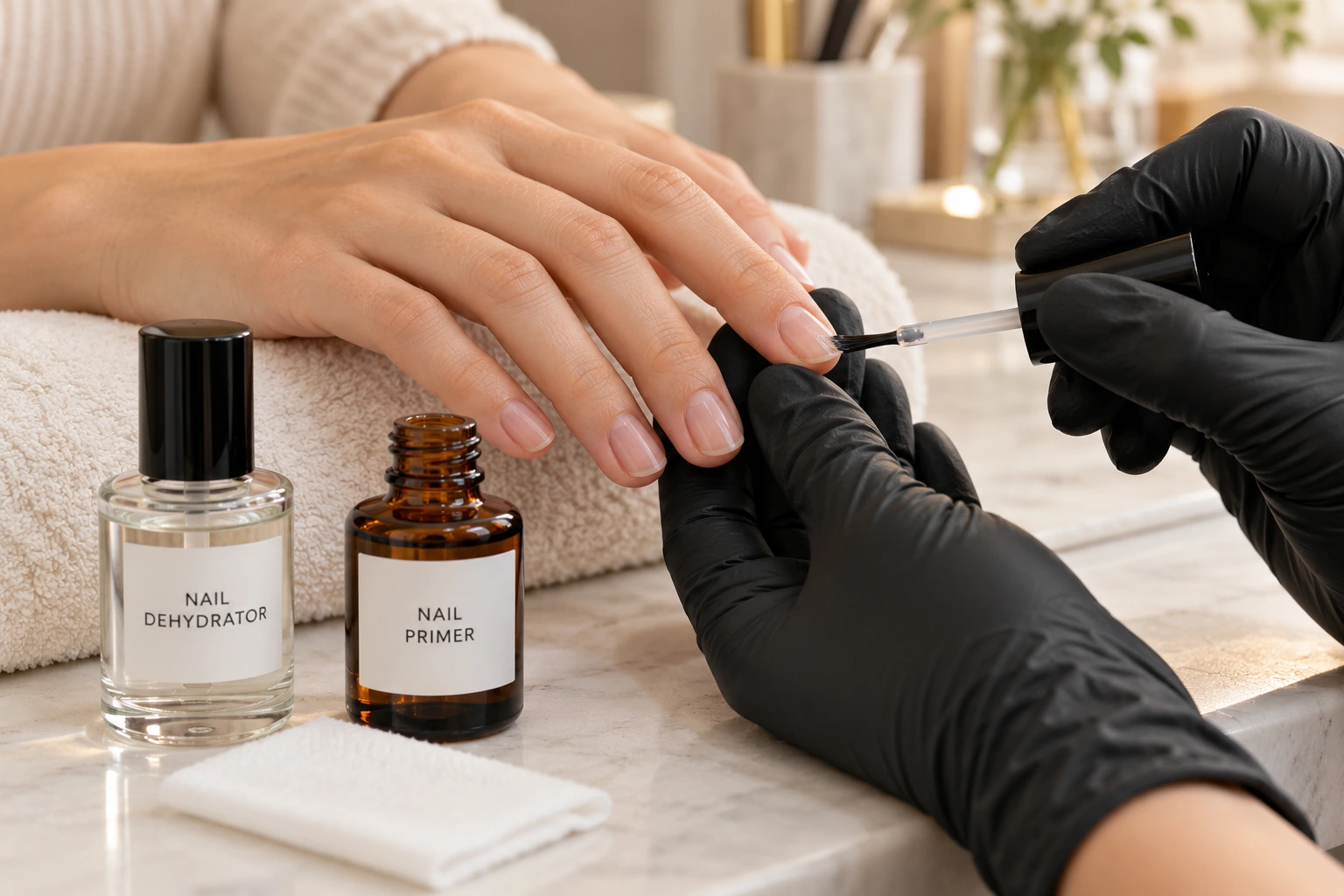
A nail dehydrator is generally used to remove temporary surface moisture and oils from the nail plate, while a primer is an adhesion product whose chemistry and instructions depend on the system. They are not interchangeable, and neither should automatically be applied in extra layers to solve lifting. For gel polish and builder services in Irish salons, preparation should follow the specific manufacturer’s protocol while minimising avoidable chemical exposure to skin.
Why preparation matters before the first base layer
A gel coating needs an appropriate, clean nail surface to bond as intended. Residual surface contamination, incompatible products, incorrect application or curing, and the nail’s condition can all affect wear. However, a manicure that lifts after several days does not prove that too little primer was used. Peeling at the free edge of gel polish may involve flexibility, mechanical stress and application thickness rather than adhesion at the cuticle alone.
The proper preparation sequence depends on the gel system. Some products are designed to be used without a separate primer; others have a named adhesion product. Applying several brands together without checking compatibility can introduce unnecessary variables and risk.
What does a dehydrator do?
A dehydrator is intended to prepare the surface by temporarily reducing moisture or oils that may interfere with adhesion. The exact ingredients vary, so it should not be assumed that every bottle labelled “prep” or “dehydrator” is chemically identical. Dehydration of the surface is not a treatment for infections, damaged nails or underlying skin conditions. It is also not a reason to aggressively file the natural nail to make the surface rougher.
Once the surface has been prepared as instructed, repeatedly touching it with fingers or brushes that carry other products can reintroduce contamination. A clean working area and a consistent sequence are generally more valuable than adding products without purpose.
What does nail primer do?
A primer is designed to support adhesion within a specified nail enhancement system. Some formulations use ingredients that can be irritating or sensitising, and professional nail products may have instructions or restrictions for use. Products marketed as acid or acid-free should not be treated as automatically safe for every person or every application. The full ingredient list, safety information, manufacturer directions and professional suitability matter more than a single marketing label.
For allergy-related questions, what an HEMA-free label does and does not guarantee is especially relevant. “HEMA-free” does not mean a product has no potential to cause reactions, and swapping primers on your own is not an appropriate response to a suspected allergy.
Dehydrator and primer compared
| Question | Dehydrator | Primer |
|---|---|---|
| Primary intended role | Prepare surface conditions | Promote adhesion where a system calls for it |
| Always necessary? | No universal rule; follow system instructions | No universal rule; depends on system |
| Can it correct poor curing? | No | No |
| Can it treat an allergic reaction? | No | No |
| Can misuse cause harm? | Possible irritation from inappropriate exposure | Possible irritation, sensitisation or chemical injury depending on formulation |
More primer is not a reliable fix for lifting
If the coating lifts, assess where the separation begins, whether product touched skin, how the nail was prepared, the curing equipment, product age and the wearer’s activities. A thicker primer layer can conflict with directions and create additional skin-exposure risk. If the nail plate is thin or damaged, repeated buffing to improve retention may make the situation worse.
Check product storage and whether a bottle remains suitable for use. Understanding PAO symbols, batch codes and nail product expiry in Ireland helps distinguish a product handling problem from an application problem.
What Irish salons should check before combining products
- Read the specific base, primer and dehydrator instructions, including whether the products are designed to work together.
- Confirm professional-use restrictions, ingredient warnings and any required personal protective equipment.
- Use only the amounts and application areas directed by the manufacturer.
- Keep uncured product away from skin and clean accidental exposure as instructed.
- Follow the compatible curing lamp and time requirements for the actual coating system.
- Maintain accessible product labels and appropriate safety information for staff.
Irish Health and Safety Authority guidance warns that some nail preparation products and primers can cause sensitisation or chemical burns, and stresses risk assessment, staff training and safe chemical handling. Correct ventilation and hygiene are important, but they do not make direct skin exposure to reactive nail products harmless.
When the service should stop
Itching, redness, swelling, blistering, pain or a reaction around the nails can indicate irritation or allergy. Do not cover the symptoms with another gel layer or apply a different primer to see whether the reaction disappears. Stop exposure and seek appropriate medical advice; urgent help is needed for signs of a severe allergic reaction, including breathing difficulty. The guide to itchy fingers after gel or BIAB nails explains why a suspected reaction deserves attention rather than another cosmetic correction.
Similarly, a nail that is separating from the nail bed, unusually discoloured or painful should not be treated simply as an adhesion problem. A qualified professional may need to assess the condition before further nail services.
What clients can ask before booking
Clients do not need to know every ingredient to ask useful questions. A salon should be able to explain whether the chosen system requires a separate primer, what will happen if product contacts the skin, and how it handles reports of previous reactions. If a client has a history of acrylate-related allergy or unexplained reactions to nail treatments, a medical assessment may be more appropriate than trying multiple products.
Frequently asked questions
Do all gel polish manicures need primer?
No. The requirement depends on the product system and its instructions; some bases are designed to be used without a separate primer.
Is acid-free primer guaranteed not to cause allergy?
No. The term describes a product category, not an absence of every possible irritant or sensitiser.
Can I use dehydrator instead of primer?
Do not assume so. They have different intended roles. The manufacturer’s complete system instructions should determine which products are appropriate.
Safety reference
Health and Safety Authority Ireland — chemical health and safety in nail bars and salons.