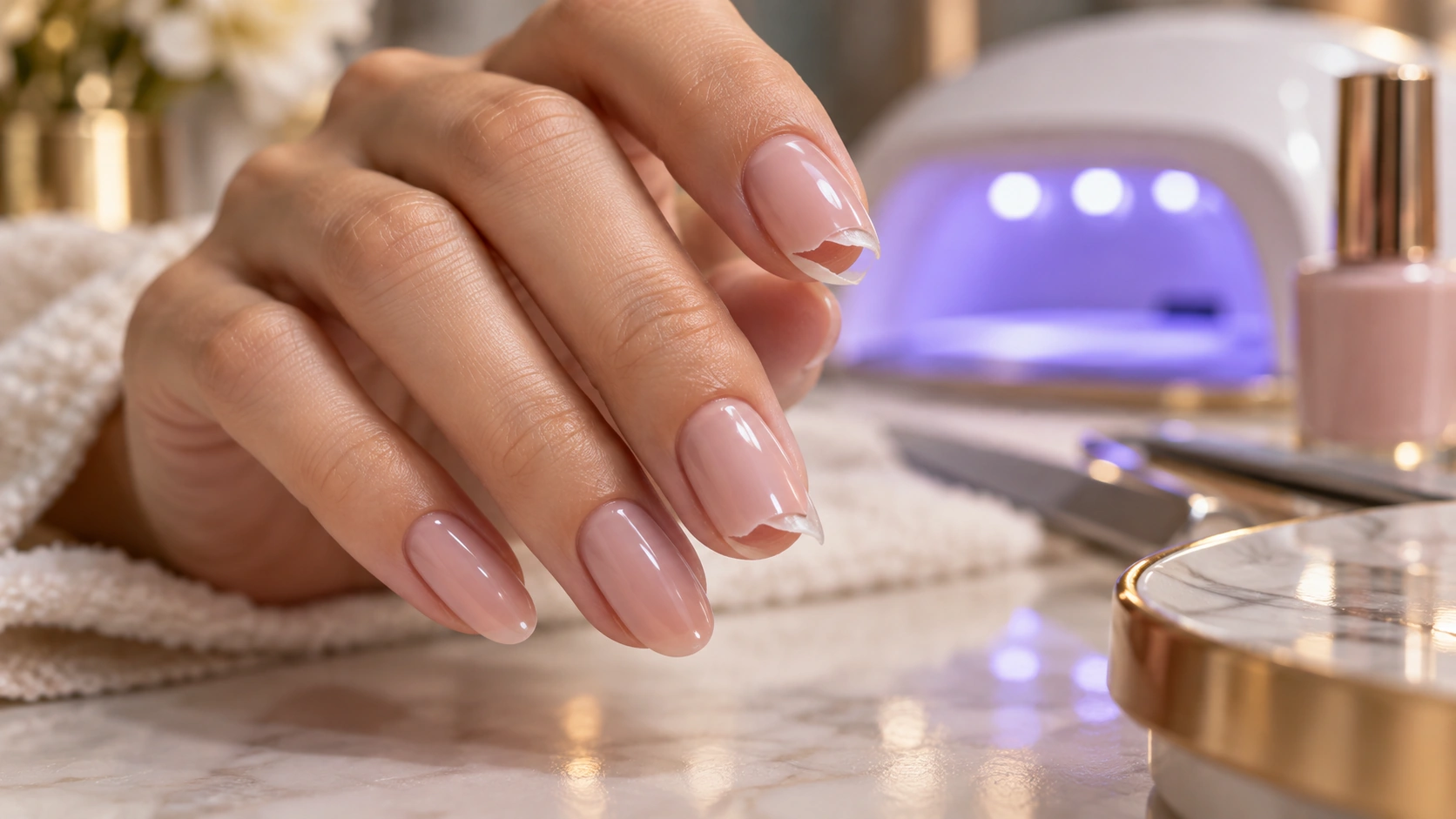
Gel polish that lifts or peels from the free edge is usually telling you that adhesion and movement are out of balance. The edge of the nail takes repeated impact, water exposure and flexing. If the natural nail is very flexible, the coating is applied too thickly, preparation leaves oil or cuticle on the plate, or the product is not cured as its manufacturer specifies, the free edge is often the first place to fail.
A single chipped corner after heavy impact is different from every nail peeling in a similar pattern. Repeated, symmetrical failure is useful information: it points toward preparation, product choice, application or curing rather than random bad luck.
Start by identifying the failure pattern
Look at what actually happened before blaming the top coat.
| What you see | What it may suggest |
|---|---|
| Thin strip lifts from several free edges | Flexing, weak edge adhesion, application or wear |
| Whole colour layer releases like a shell | Contamination, incompatible layers or curing problem |
| Only one corner chips | Local impact or shape-related stress |
| Lifting begins at sidewalls or cuticle | Product touching skin/cuticle, prep issue, flooding |
| Coating cracks across flexible nails | Coating may be too rigid for the nail movement |
The free edge is a high-stress zone
The tip of a natural nail is not static. It bends when you type, open packaging, wash hair, clean or use the nail as a tool. Water can temporarily increase the flexibility of the natural nail plate, so repeated wet-dry cycles add more movement.
A gel layer has its own flexibility. If the natural nail bends substantially while the cured coating does not move with it, stress concentrates at the bond line. That can create tiny separation that grows into peeling.
Preparation should remove contamination, not damage the nail
Adhesion needs a clean nail plate and complete removal of non-living cuticle from the area being coated. That does not mean aggressively thinning the natural nail. Over-filing can weaken the plate and make it flex more, which may make retention worse while also increasing the risk of soreness and damage.
Follow the preparation method for the specific product system. Some systems require a particular cleanser, dehydrator or primer; others do not. Adding extra chemicals because another brand uses them can create compatibility problems.
“Cap the edge” is not a universal magic fix
Some gel systems instruct the technician to lightly seal the free edge; others have different application guidance. A thick ridge wrapped under a short nail can create bulk, catch on objects and make the edge easier to lever away.
The correct approach is the manufacturer’s application method, with controlled product thickness. If the instructions call for sealing the edge, it should be thin and intentional rather than a bead of product hanging underneath.
Layer thickness matters for both retention and curing
Gel polish is designed to cure within a specified layer thickness. Applying one heavy coat instead of two controlled coats can cause wrinkling, uneven curing or a surface that appears hard while deeper material has not cured as intended.
This is not solved by guessing a longer cure. The correct lamp, layer thickness and cure schedule are part of one system. Dermatology organisations have warned that uncured or inadequately cured methacrylate-containing nail products can increase the risk of allergic sensitisation, particularly when uncured material contacts skin.
Do not mix lamp advice from social media with a different gel system
A lamp can look powerful and still be unsuitable for a particular product. Gel formulations respond to specific wavelengths, intensity and exposure conditions. Use the lamp and curing instructions specified or validated by the manufacturer of the gel system.
If a brand requires a matched lamp, changing to an unrelated lamp because it has a larger wattage number is not a reliable method of improving retention.
Flexible nails may need a different service
Very thin or flexible nails can be difficult to keep covered with a rigid coating. In some cases a compatible flexible base or a properly selected overlay can reduce movement, but that decision should be based on nail condition and the products available in the system.
More product is not always better. A thick overlay placed on a weak, damaged or peeling nail plate can increase leverage. If the natural nail is compromised, the priority is to avoid further trauma rather than hiding the problem under extra material.
Shape changes the mechanical load
A square nail with sharp corners exposes those corners to repeated knocks. A very long free edge creates more leverage. If the same client repeatedly chips the corners, slightly softening the shape or reducing length may improve real-world durability without changing products.
Retention should be evaluated together with lifestyle. Someone working with boxes, cleaning products or frequent handwashing may need a different length and maintenance interval from a client whose hands experience less mechanical stress.
Water and household chemicals
Gel should not dissolve in ordinary water, but the natural nail underneath changes with repeated soaking and drying. Cleaning chemicals can also affect skin and surface finish. Gloves are useful for prolonged wet work and cleaning — not as a guarantee against lifting, but as sensible protection for nails and skin.
When peeling should not simply be re-covered
If the nail is painful, red, swollen, itchy, blistered, separating from the nail bed or showing another unexplained change, do not repeatedly reapply gel to hide it. Persistent skin reactions around gel nails deserve appropriate medical assessment. Green discolouration under a lifted coating also needs the product removed and the nail assessed rather than sealed underneath another layer.
How a salon can troubleshoot repeated free-edge peeling
- Photograph the failure before removal.
- Record which nails fail first and after how many days.
- Check whether the natural nails are flexible, damaged or unusually thin.
- Confirm prep products, base, colour, top coat and lamp belong to a compatible system.
- Review product thickness and whether the free edge was applied according to manufacturer instructions.
- Check the client’s usual nail length, shape and daily mechanical exposure.
- Change one variable at a time so the cause can actually be identified.
If you prefer professional application, you can browse nail businesses around Ireland through Nails Ireland.