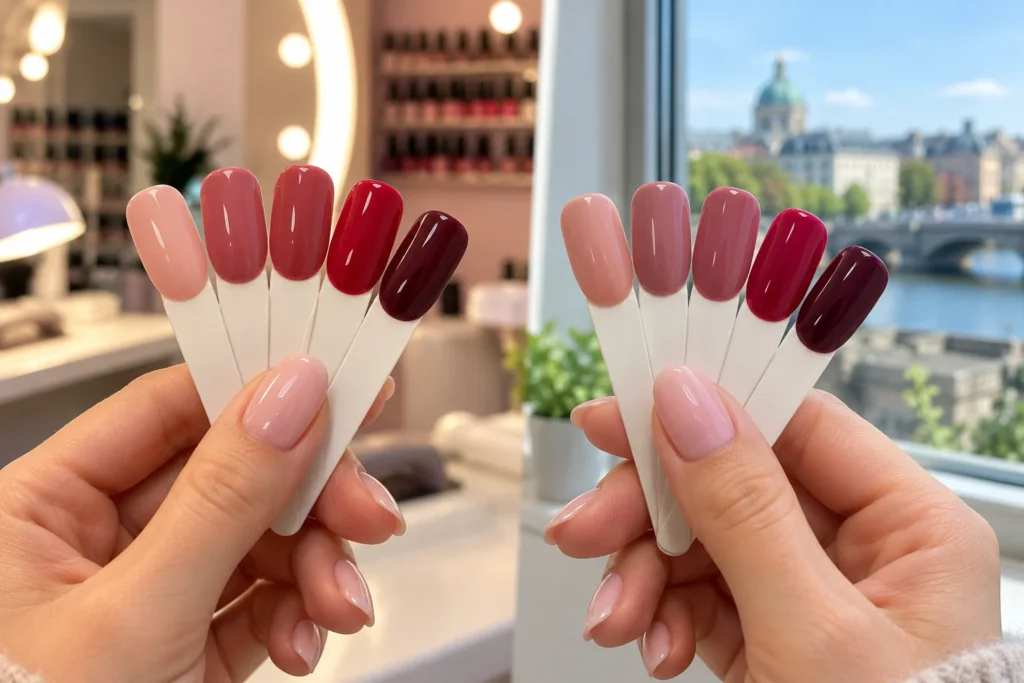
A gel polish or BIAB colour can appear warmer, cooler, brighter or more muted under different lighting even when the product has not changed. Nail salon lamps, daylight, phone screens and glossy top coats affect how the eye perceives a shade. The best way to avoid disappointment is to compare suitable samples in more than one type of light, decide how much coverage you want and describe your desired finish before application.
Why the same nail colour does not look identical everywhere
Light sources do not all contain the same mix of wavelengths. A warm indoor lamp may make beige or pink shades look more yellow, while cool lighting can emphasise blue or grey undertones. A phone screen adds another layer of variation because brightness, colour settings and photo processing differ between devices. None of these necessarily means the salon used the wrong colour.
Finish matters too. A high-gloss top coat reflects bright highlights, a matte top changes contrast, and shimmer or cat-eye particles respond strongly to the angle of light. A swatch photographed under a ring light may therefore differ noticeably from the same manicure outdoors on an overcast day.
Start with opacity, not just the shade name
Two pale pink products can create entirely different results if one is sheer and one opaque. A sheer pink allows the natural nail underneath to influence the final colour, while a more opaque product largely covers it. The underlying base shade can also change the appearance of a translucent colour.
Before choosing, decide whether you want your nail line visible, softly blurred or fully covered. The guide to milky white and sheer nude nails explains why coverage is often a more useful starting point than the printed colour name.
Ask to see a real swatch where possible
A salon swatch painted and cured using the correct product is generally more informative than a tiny digital thumbnail. Ask whether the sample represents the number of layers the technician normally uses and whether it has a glossy or matte finish. Look at the swatch against your fingers, not just against a white display board.
If the salon has natural daylight near a window, check the colour there as well, without interrupting the appointment. A quick move away from a strong manicure lamp can reveal whether a nude reads peach, pink, mauve or beige in the conditions you will see most often.
How skin tone and nail length influence the result
Skin tone, undertone and surrounding clothing can affect colour perception. There is no universal rule that a particular undertone “must” wear a specific shade. Someone who likes contrast may intentionally choose a cool nude against warm skin; another person may prefer a shade closer to their natural nail colour.
Short nails sometimes make a colour appear more concentrated because less of the nail surface is visible. Thin tips, negative space and soft translucency can change the impression without requiring longer extensions. If you are considering a delicate edge, see micro French nails on short natural nails for how tip width and shape affect the finished design.
Compare colours by use, not by trend alone
| Desired effect | What to compare | Possible surprise |
|---|---|---|
| Natural manicure | Sheerness, pink or beige undertone | More visible nail line than expected |
| Deep burgundy | One layer versus two, warm versus cool light | Looks almost black indoors |
| Chrome or cat-eye | Lighting angle and reflective top finish | Much subtler outside a spotlight |
| Pastel | Base colour and actual opacity | Looks cooler under a daylight lamp |
| French manicure | Base tint and tip contrast | White edge looks harsher on a very sheer base |
When browsing seasonal nail colour ideas for Ireland, treat photographs as inspiration rather than exact colour standards. Ask for a product shade or a real comparison swatch instead of relying solely on a social media filter.
What to tell your nail technician
A useful request has three parts: the colour family, the desired level of coverage and the finish. For example: “A cool pink, semi-sheer, with a glossy finish; I do not want it to look peach indoors.” This gives a technician more guidance than saying only “a natural nude.” You can also show two reference photos and explain which part you prefer in each.
If you dislike a colour after the first test nail, say so before every nail is completed. Changes are usually easier to discuss early, although whether the product can be adjusted safely depends on the service and the stage of application. Never ask a salon to rush or shorten the appropriate curing procedure to save time.
Why wedding nail trials are especially useful
For a wedding, a manicure will be seen in different settings: daylight, indoor reception lighting and professional photographs. An earlier trial gives you a chance to assess how the shade appears beside your dress, jewellery and bouquet. The article on planning wedding nails in Ireland explains how to schedule a trial without leaving colour decisions until the final appointment.
When taking your own reference photos, use a clean background, avoid extreme filters and include one picture in diffuse daylight. A screenshot of a screenshot may distort the shade even further. If the nail product name is known, keep it with your booking notes.
Safety and realistic expectations
Colour perception is separate from product safety. Lamps and gels should be used according to the manufacturer’s instructions, and the technician must follow appropriate preparation and curing practices. A desired colour result is not a reason to mix incompatible systems or apply excessively thick layers.
If your skin feels itchy, swollen or painful after a manicure, treat that as a possible reaction rather than a harmless colour issue and seek suitable professional advice. A cosmetic shade preference should never override nail or skin health.
Frequently asked questions
Why does nude gel polish look orange outdoors?
The shade may have a warm undertone, and the surrounding daylight may reveal it more clearly than salon lighting. The base colour and number of layers can also contribute.
Can the salon guarantee that my nails match a photo exactly?
Not reliably. Screen settings, lighting, nail shape, natural nail colour and photographic processing vary. A physical swatch is usually a better reference.
Does a top coat change the colour?
It can change the perceived finish and reflected light; some tinted tops also alter the colour itself. Ask which finish was used in the sample.
What is the safest point to change my mind?
Discuss your concern as early as possible and let the technician explain the options for the specific system. Do not pick or peel cured product at home to correct a colour you dislike.
The right shade is the one you like in everyday light, at the coverage and finish you actually want. A two-minute conversation about swatches and undertones can be more valuable than comparing dozens of heavily edited photographs.