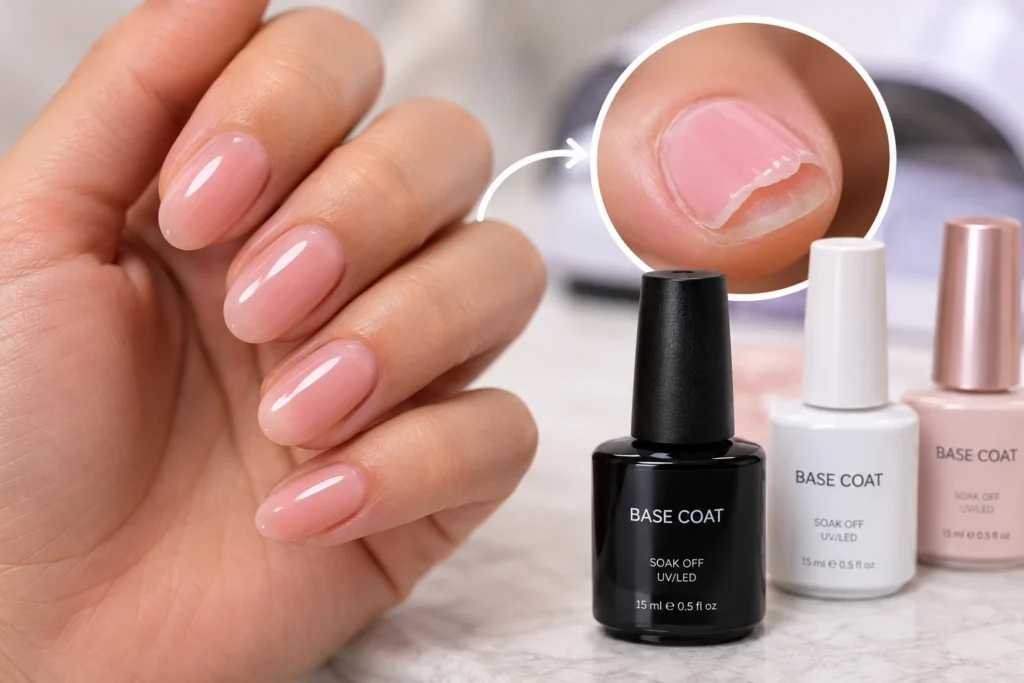
If your gel polish looks perfect for the first few days but starts lifting around the edges by day four or five, the base coat may not be providing the right combination of adhesion and flexibility for your natural nails. However, switching to a stronger base coat is not always the solution. The location of the lifting, your nail condition, preparation technique and curing system all affect how long a gel manicure lasts.
For thin, flexible or peeling natural nails, a high-quality rubber base coat is often the best alternative to a standard gel base. Its flexible structure allows it to move with the natural nail instead of separating when the nail bends. For strong, relatively rigid nails, a thin adhesion-focused base coat may work better. If your nails are weak, break easily or need structural support, a compatible builder base may be more appropriate.
Before buying another product, however, it is worth understanding why your current gel manicure starts lifting after only four or five days. The difference between a manicure that lasts less than a week and one that stays intact for two weeks or longer often comes down to identifying the actual cause rather than simply applying a thicker or stronger product.
Why Does Gel Polish Start Lifting After Four or Five Days?
Gel polish is designed to form a durable coating that adheres to the natural nail. Unlike ordinary nail varnish, gel products are cured using a suitable UV or LED nail lamp, which initiates a chemical reaction that hardens the coating.
When the system is properly selected, applied and cured, many professional gel manicures are intended to last around two weeks or longer. Results vary according to nail condition, the products used and everyday activities.
Lifting within four or five days suggests that something is interfering with the bond between the gel and the natural nail, or that the coating is being stressed beyond what it can tolerate.
The most common contributing factors include:
- Insufficient nail preparation: Residual oils, moisture, dust or non-living cuticle tissue can prevent the base coat from adhering properly.
- An unsuitable base coat: A rigid coating may not accommodate the movement of naturally flexible nails.
- Gel touching the surrounding skin: Product that flows into the sidewalls or cuticle area can start lifting as the nail grows and moves.
- Incorrect curing: An incompatible lamp, insufficient exposure or excessively thick layers can prevent proper polymerisation.
- Poor free-edge coverage: The exposed tip of the nail is vulnerable to mechanical wear, chipping and separation.
- Natural nail damage: Peeling layers, splitting or excessive filing can leave an unstable surface for the gel to adhere to.
- Everyday mechanical stress: Frequent cleaning, prolonged water exposure, typing, picking at objects or using nails as tools can contribute to premature lifting.
The important detail is that these problems require different solutions. A rubber base may help when the nail flexes excessively, but it will not compensate for uncured gel, product applied onto skin or inadequate preparation.
Which Type of Gel Base Coat Provides the Best Hold?
There is no single gel base coat that provides the best retention for every person. The most suitable choice depends primarily on the condition and flexibility of the natural nail, the type of gel polish being applied and the manufacturer’s recommended application system.
| Base Coat Type | Best Suited To | Main Advantage | When to Consider Switching |
|---|---|---|---|
| Standard Gel Base Coat | Healthy, relatively strong natural nails | Creates a thin adhesive foundation without unnecessary thickness | Keep using it if the nails are healthy and the problem can be corrected through preparation or application |
| Rubber Base Coat | Thin, flexible, flaky or mildly peeling nails | Provides additional flexibility and a degree of support | Consider it when the natural nail bends and gel repeatedly lifts from the tips or sides |
| Adhesion-Focused or Bonding Base | Healthy nails that repeatedly experience adhesion problems | Designed to improve the bond between the prepared nail and compatible gel products | Consider it when preparation and curing have been checked but premature separation continues |
| Builder Base or Soak-Off Builder Gel | Weak nails that need additional reinforcement | Adds structure and support while helping protect nails from mechanical stress | Consider it when nails bend excessively, break or split beneath conventional gel polish |
1. Rubber Base Coat: A Good First Choice for Thin or Flexible Nails
If your natural nails are thin, bend easily or feel slightly soft, a rubber base is one of the first alternatives worth discussing with a qualified nail technician.
The term rubber base refers to a type of gel base formulated to offer flexibility and often a slightly thicker consistency than conventional base coats. It does not mean the product is made from ordinary rubber.
Natural nails are not completely rigid. They bend during everyday activities, particularly near the free edge. If the natural nail flexes more than the cured coating can accommodate, stress can develop between the nail plate and the gel. Over time, this may contribute to cracking, chipping or lifting.
A suitable flexible base is designed to accommodate some of that movement.
When Is Rubber Base Particularly Useful?
- Your nails bend easily when you apply light pressure near the tips.
- Your gel frequently lifts from the free edge rather than the cuticle.
- Your natural nails are thin or prone to flaking.
- You have short or medium-length natural nails and want additional support without a heavy overlay.
- Conventional gel polish frequently chips or separates despite careful preparation.
One example is Gelish Foundation Flex, a flexible rubber base designed for thin, peeling or highly flexible nails. Gelish distinguishes this product from its standard Foundation base, which is intended for normal, healthy nails.
Other professional gel systems offer comparable flexible bases, although their formulations and curing requirements are not identical. Choose a product that is approved for use with your existing gel system, rather than selecting one solely because it is advertised as particularly strong.
Can Rubber Base Make Gel Polish Last Longer?
It can improve retention when excessive nail flexibility is contributing to lifting. However, the improvement is not guaranteed, and a rubber base will not necessarily outperform a standard base on naturally firm nails.
Rubber base also needs to be applied correctly. A very thick layer is not automatically more durable. Excessive thickness can create an uneven coating and, depending on the formulation and lamp, increase the risk of incomplete curing.
For ordinary gel polish on short natural nails, a controlled, thin application of rubber base may be sufficient. Additional structure should only be added when the specific product is designed for that purpose.
2. Adhesion-Focused Base Coat: Better for Nails That Are Strong but Still Lift
Suppose your natural nails are healthy, relatively rigid and do not bend much, but your gel polish still begins separating after a few days. In that situation, switching immediately to a thick rubber base may be unnecessary.
A professional adhesion-focused base, sometimes described as a bonding base or high-adhesion base gel, may be a more appropriate choice.
These products are formulated to create a reliable bond between the properly prepared nail plate and subsequent gel layers. Depending on the system, they may be used directly on the nail or together with a specific preparation product.
Look for a base coat that:
- Is specifically designed for gel polish adhesion.
- Is suitable for your natural nail type.
- Is compatible with your gel colour and curing lamp.
- Has clear preparation, curing and removal instructions.
- Does not require additional primer unless specified by the manufacturer.
A stronger bond is not always the same as a healthier manicure. Products that adhere exceptionally firmly may also require different removal techniques. Repeatedly scraping or forcing stubborn gel from the nail can cause considerable damage.
The objective is to achieve reliable retention while preserving the natural nail plate.
3. Builder Base: When Your Nails Need More Than Adhesion
A builder base or suitable soak-off builder gel may be beneficial if your nails are not only lifting but also bending, breaking or splitting beneath the manicure.
Builder products are designed to provide additional structure. They can reinforce the natural nail, improve its shape and help distribute mechanical stress more effectively.
For example, Gelish Brush-On Structure is positioned as a strengthening option for nails that need more support than a standard base layer. Other professional systems offer builder gels in bottles for natural nail overlays.
However, a builder gel is not simply a more powerful version of an ordinary base coat.
Some builder products require a separate bonding base, while others are formulated for direct application to the natural nail. Certain builder gels soak off, while others must be professionally filed down for removal. Product requirements vary considerably.
Adding unnecessary thickness can also create new problems. A heavy, poorly balanced overlay may place additional leverage on the nail, particularly as it grows longer.
Choose builder gel when structural support is genuinely needed, not simply because ordinary gel polish started lifting after four days.
Where Does Your Gel Polish Lift? The Location Often Reveals the Problem
Before changing base coats, examine where the gel first separates from the nail. The pattern can help narrow down the likely cause.
| Where the Lifting Starts | Possible Cause | What to Check First |
|---|---|---|
| At the very tip of the nail | Unsealed free edge, natural nail flexibility, wear or impact | Free-edge application, nail length and suitability of a flexible base |
| Around the cuticle | Residual cuticle tissue, oil or gel touching the skin | Preparation around the nail base and product placement |
| Along the sidewalls | Product flooding onto skin, uneven coverage or repeated side pressure | Application precision and sidewall clearance |
| Across most of the nail at once | General adhesion failure or an unsuitable preparation and curing system | Cleaning, preparation products, base compatibility and lamp performance |
| Only on one or two fingers | Localised damage, repeated mechanical stress or differences between nails | Daily activities, nail condition and the affected fingers |
| In small bubbles beneath otherwise attached gel | Localised separation, impact or a possible curing issue | Application thickness, curing and underlying nail condition |
If the Gel Lifts at the Free Edge
Free-edge lifting is especially common on nails that bend easily, peel at the tips or experience repeated physical stress.
The free edge is the part of the nail that extends beyond the fingertip. Unlike the rest of the nail plate, it is not supported directly by the nail bed and is therefore more exposed to movement and impact.
If this is where your lifting consistently begins, check whether the technician has applied the base, colour and top coat according to the manufacturer’s free-edge sealing instructions.
On nails with a visible free edge, this commonly involves applying a very thin amount of product along the tip to create continuous coverage. Excessive product should be avoided, and the gel must not touch the surrounding skin.
On extremely short nails, sealing the edge can be difficult. It is more important to maintain safe, accurate application than to force gel underneath the fingertip.
If the natural nail bends significantly, a flexible rubber base may be helpful. If the nail itself is peeling into layers, however, the underlying nail condition also needs attention.
If the Gel Lifts Around the Cuticle
When lifting begins near the base of the nail, switching to a rubber base may make little difference.
A common cause is a small amount of non-living cuticle tissue remaining on the nail plate. Gel applied over this tissue does not have the same stable foundation as gel correctly bonded to the prepared nail.
Product that touches the skin can also contribute to lifting. As the nail grows and the skin moves, the gel may begin separating from the surrounding area.
Preparation should involve safely removing adherent non-living tissue from the nail plate while protecting the living skin and natural cuticle barrier.
Cutting or aggressively removing healthy living tissue is unnecessary and can increase the risk of irritation or infection.
If the Gel Lifts Along the Sides
Sidewall lifting often points towards application technique.
Gel products can flow towards the lateral nail folds before curing, especially when a generous amount of product is applied. Once the gel touches the skin, the contact can compromise the manicure and increase the risk of acrylate sensitisation.
A small, consistent margin should remain between the gel and the surrounding skin. Any uncured material that reaches the skin should be removed safely before curing.
A base coat with a more controllable consistency may make precise application easier, but changing the product alone will not solve persistent flooding.
How to Improve Gel Polish Retention Before Changing Products
Even the most suitable base coat depends on correct preparation and application. A carefully controlled process is usually more reliable than adding extra layers or stronger primers without identifying the cause of lifting.
Step 1: Examine the Condition of the Natural Nail
Look for peeling, splitting, excessive flexibility, rough patches or signs of damage from previous gel removal.
If the nail plate is visibly thin or damaged, repeated aggressive preparation may make the problem worse. The safest approach may be to allow the nail to recover or seek advice from a qualified professional before applying another enhancement.
Step 2: Prepare the Nail Without Over-Filing
Preparation should follow the exact requirements of the gel system.
Some professional systems require gentle removal of surface shine, while others are specifically designed to adhere without buffing the natural nail.
There is no universal requirement to roughen every nail aggressively. Removing healthy nail layers can make nails thinner, more flexible and more vulnerable to damage.
Any preparation should be gentle and should preserve the integrity of the natural nail.
Step 3: Remove Dust, Surface Oils and Residual Moisture
Oil, dust and moisture can interfere with adhesion when present on the nail immediately before applying the base coat.
Use the cleanser or nail preparation product recommended by the manufacturer. Avoid applying hand cream or cuticle oil immediately before the gel service unless the complete preparation procedure accounts for it.
Once prepared, try not to touch the nail plate with your fingertips before base application.
There is also no advantage to repeatedly using harsh dehydrating products beyond the manufacturer’s instructions. Excessive preparation can irritate the surrounding skin and contribute to poor nail condition.
Step 4: Apply the Base Coat Correctly
The initial base layer should be applied in accordance with the manufacturer’s directions, typically as a thin, even coating.
Pay particular attention to coverage near the edges, without allowing uncured gel to touch the skin.
A thicker layer does not necessarily create better adhesion. In some systems, applying too much product can make proper curing more difficult.
If a builder system requires a separate structured layer, follow its specific application method rather than treating all base coats as interchangeable.
Step 5: Check the Curing Lamp
An unsuitable curing lamp can cause problems even when the nail preparation and base coat appear correct.
Gel products are formulated to cure under specific light conditions. The lamp’s wavelength output, intensity, product formulation, layer thickness and curing instructions all matter.
A lamp labelled 48W or 72W is not automatically compatible with every gel polish. Wattage alone does not establish whether a product will cure correctly.
Use a lamp approved or specifically validated for the gel system whenever possible. Follow the stated curing times and positioning instructions, including any requirements for curing thumbs separately.
Do not assume that a gel is fully cured simply because its surface feels hard.
Incomplete curing can affect durability and may leave reactive ingredients that increase the risk of developing a contact allergy.
Step 6: Apply Colour and Top Coat in Suitable Layers
Colour application matters just as much as the base layer.
Excessively thick coats, particularly with heavily pigmented colours, can interfere with curing. Follow the product instructions rather than attempting to achieve full coverage with a single heavy layer.
Apply the top coat as directed, ensuring appropriate coverage around the free edge where the nail length permits it.
After curing, avoid filing through the sealed edge unless the gel system specifically requires further finishing and resealing.
Do You Need a Nail Primer to Stop Gel Lifting?
Not necessarily.
Nail primers and bonding preparations are designed to support adhesion in particular nail systems, but some modern gel bases do not require a separate primer at all.
Adding a primer without checking compatibility can introduce unnecessary complexity and may not improve retention.
A primer may be appropriate when it forms part of the manufacturer’s approved preparation procedure or when a professional has identified a genuine adhesion problem that the system is designed to address.
It should not be treated as an automatic solution for every manicure that lifts after a few days.
Acidic primers also require particular care because inappropriate application can irritate or damage the skin and nails.
If you are using a complete professional gel system, follow its instructions before introducing additional bonding products from another brand.
Should You Use Rubber Base and Builder Gel Together?
Some professional nail systems use a flexible base underneath a builder product, while others incorporate the necessary bonding properties into the builder gel itself.
Whether these products should be combined depends on their formulation and the manufacturer’s instructions.
For example, some Builder in a Bottle systems require a separate base for specific shades or product ranges, while other formulations are intended for direct application to the natural nail.
Applying rubber base beneath builder gel is therefore not a universal rule.
Combining products without confirming compatibility may affect adhesion, flexibility, curing or removal. If your primary problem is mild free-edge lifting on short, flexible nails, a correctly selected rubber base beneath gel colour may be sufficient without adding a builder layer.
What About HEMA-Free Gel Base Coats?
However, HEMA-free does not mean allergy-free.
Other acrylates and methacrylates may still be present, and these ingredients can also cause sensitisation. Someone who has developed an allergy to one acrylate may react to other related substances.
The British Association of Dermatologists has warned about allergic reactions associated with artificial nail products, particularly where uncured material contacts the skin or products are not cured correctly.
Do not attempt to resolve suspected allergic reactions simply by changing to a different base coat or choosing a product labelled HEMA-free.
Could Your Everyday Activities Be Causing the Lifting?
Even a carefully applied gel manicure experiences considerable physical stress during ordinary daily activities.
Repeated water exposure, contact with household cleaning products and mechanical pressure can all affect wear.
Some activities place particular stress on the free edge:
- Using fingernails to open packaging or remove labels.
- Picking at adhesive tape or scratching hard surfaces.
- Frequent contact with water during cleaning or washing.
- Repeatedly striking the nail tips against hard surfaces.
- Allowing long natural nails to bend or catch on objects.
- Picking at an already lifted section of gel polish.
If your manicure always lifts on the same fingers, examine how those fingers are used during everyday tasks.
For example, lifting that repeatedly affects the index finger and thumb may be related to activities that place pressure on those particular nails.
Wearing protective gloves when cleaning and avoiding using nails as tools can help reduce unnecessary stress.
Cuticle oil can also form part of ordinary nail care after the gel has been correctly cured. Moisturising the surrounding skin and nails is beneficial; there is no need to avoid cuticle oil throughout the life of a properly applied manicure.
The important distinction is between oil remaining on the nail during preparation and moisturising the skin after the manicure is complete.
Should You Remove Gel Polish as Soon as It Starts Lifting?
Yes. Once gel begins separating from the natural nail, it should be assessed and safely removed or corrected by a suitably trained professional rather than left to spread.
A lifted area may catch on clothing or hair, placing additional force on the natural nail. Gaps can also trap moisture and debris.
Do not press loose gel back into place with household glue, and do not simply cover a separated area with another layer of product.
Most importantly, avoid peeling the gel from the nail. Pulling off an adhered section can remove superficial layers of the natural nail plate, leaving it thinner and more vulnerable to future problems.
The correct removal technique depends on the product. Some gel systems are designed to soak off, while certain harder builder formulations require controlled professional filing.
If you notice green, dark or unusual discolouration, pain, swelling, drainage or persistent nail separation, avoid reapplying cosmetic products until the nail has been appropriately assessed.
How Can You Tell Whether the New Base Coat Is Actually Better?
Changing several products and preparation steps at the same time makes it difficult to determine what solved the problem.
A more useful approach is to identify the most likely cause, make one appropriate change and observe the result over subsequent manicures.
For example, if your nails are flexible and the gel consistently lifts at the tips, switching to a compatible rubber base while keeping the remaining application process consistent can help you assess whether flexibility was the missing factor.
If the gel begins lifting around the cuticles, correcting product placement or preparation may be a better first test than changing the base.
Record the following details:
- The base coat and gel system used.
- The condition and approximate length of the natural nails.
- The first day on which lifting becomes visible.
- The exact location where separation starts.
- Whether the problem affects every nail or only certain fingers.
- Any repeated activities or incidents that may have stressed the nails.
If a new base improves wear from four or five days to around two weeks without nail damage or irritation, that is a meaningful improvement. If the same lifting pattern continues, preparation, curing, technique or nail health deserve further investigation.
Frequently Asked Questions About Gel Polish Lifting
What is the best gel base coat for nails that keep lifting?
For thin, flexible or peeling nails, a compatible rubber base is often a sensible first option because it can accommodate natural nail movement. For strong, healthy nails, an adhesion-focused base may be more suitable. A builder base is worth considering when additional structural support is required. The best choice depends on why the gel is lifting.
Will rubber base stop gel polish peeling off after five days?
Rubber base may improve wear if peeling is related to nail flexibility or insufficient support. It will not necessarily solve lifting caused by oils, residual cuticle tissue, gel touching the skin, incorrect curing or damaged nails. These factors need to be addressed separately.
Is rubber base stronger than ordinary gel base coat?
Rubber base is generally designed to provide greater flexibility and often more support than a conventional thin gel base. That does not automatically make it more durable on every nail type. Greater flexibility is beneficial in some circumstances, while other nails may perform better with a standard or adhesion-focused base.
Why does my gel polish lift at the tips but not near the cuticles?
Tip lifting can occur when the free edge is insufficiently covered, the natural nail bends more than the coating can accommodate, the nail plate is peeling or the tips experience repeated mechanical stress. Check nail flexibility, free-edge coverage, nail length and everyday activities before selecting a different base.
Why does my gel lift on the sides after a few days?
Sidewall lifting frequently suggests that gel has reached the surrounding skin or that the product has not been applied evenly near the edges. Improving application precision and keeping uncured product away from the skin should be prioritised before switching brands.
Can I put rubber base underneath any gel polish?
Not automatically. Although some professional gel products are compatible across brands, this should never be assumed. Choose combinations approved by the manufacturers, particularly because different formulas can have different curing requirements. A complete, validated gel system is generally the more predictable option.
Do I need to buff my nails before applying rubber base?
Follow the instructions for the particular product. Some rubber base systems require very gentle surface preparation, while other gel systems do not require buffing. Aggressive filing is not necessary and may make naturally thin nails more fragile.
Should I apply two coats of rubber base for better adhesion?
Only when the manufacturer recommends that application method. Some rubber bases are intended for multiple controlled layers, while others require a different technique. Applying additional product without following the instructions does not guarantee improved adhesion and can interfere with curing.
Will a more expensive gel base coat last longer?
Price alone is not a reliable indicator of retention. A well-formulated base that suits your natural nails, is correctly applied and is cured with a compatible lamp may perform better than a more expensive product that is unsuitable for your nail condition.
Can dehydration products stop early lifting?
An approved nail preparation product can help remove temporary surface moisture and oils before application. However, a dehydrator is not a substitute for proper preparation or correct curing. Excessive use of harsh products is unnecessary and may irritate the surrounding skin.
Can I apply builder gel over peeling natural nails?
A suitable builder system may help protect some weak nails, but it should not be used to conceal significant damage, infection or ongoing nail separation. If the natural nail is severely peeling or damaged, professional assessment and a period of recovery may be more appropriate.
How long should gel polish last without lifting?
Many professional gel polish systems are designed to provide approximately two weeks of wear, with some offering longer retention when used correctly. Actual results vary. Consistent lifting after four or five days is worth investigating, especially if it occurs repeatedly on several nails.
Is it normal for gel polish to lift after frequent handwashing?
Properly applied and cured gel polish should tolerate ordinary handwashing. Repeated prolonged immersion, cleaning chemicals and physical stress can contribute to wear, but routine washing alone should not automatically cause the entire manicure to lift within a few days.
The Best Base Coat to Try Next: A Practical Recommendation
If you have been using a standard gel base coat and your manicure consistently starts lifting after four or five days, the most useful next step depends on your natural nails and where the problem starts.
If your nails are thin, flexible and lift mainly at the free edge: Try a professional, soak-off rubber base that is compatible with your gel system. Gelish Foundation Flex is one example of a product specifically developed for this type of nail.
If your nails are healthy and relatively firm but gel separates around the edges: Check preparation, skin contact, free-edge coverage and curing first. If those factors have been addressed, consider a compatible high-adhesion base rather than automatically adding more thickness.
If your nails are weak, break easily or need more support: A professionally applied builder base or suitable builder overlay may offer better protection and structural stability than an ordinary thin base coat.
If the lifting starts around the cuticle or sidewalls: Focus on preparation and application accuracy before changing products. Even an excellent base coat cannot create a reliable bond when applied over residual tissue or onto surrounding skin.
If your gel peels away in large sections or repeatedly fails across several nails: Check the complete product system, especially nail preparation and lamp compatibility, rather than assuming that the base coat alone is responsible.
For most people experiencing persistent lifting, the answer is not to use the thickest, hardest or strongest-sounding product available. It is to choose a base that suits the natural nail and apply it as part of a properly matched, correctly cured gel system.
A comfortable manicure that stays securely attached, maintains the condition of the natural nails and can be removed without unnecessary damage is a better result than one that achieves extra wear at the expense of nail health.
Further Reading and Professional Guidance
- Gelish – Understanding Different Gel Base Coats – Manufacturer guidance comparing standard base gels, flexible rubber bases and strengthening builder products.
- Essie – Nail Preparation and Polish Application Advice – Information about nail preparation, cuticle care, free-edge coverage and common reasons for premature polish wear.
- American Academy of Dermatology – Gel Manicures: Tips for Healthy Nails – Dermatologist advice on protecting natural nails, safe removal and reducing potential damage.
- British Association of Dermatologists – Artificial Nail Allergy and Home Kit Safety – Medical guidance concerning acrylate allergies, uncured gel products and risks associated with unsuitable application systems.